
SceneProgressive Rock
Progressive Folk
- StyleFolk rock, progressive rock, Celtic rock, medieval and Renaissance influences
- RootsLate 1960s, Britain
- In this guide8 bands · 64 albums
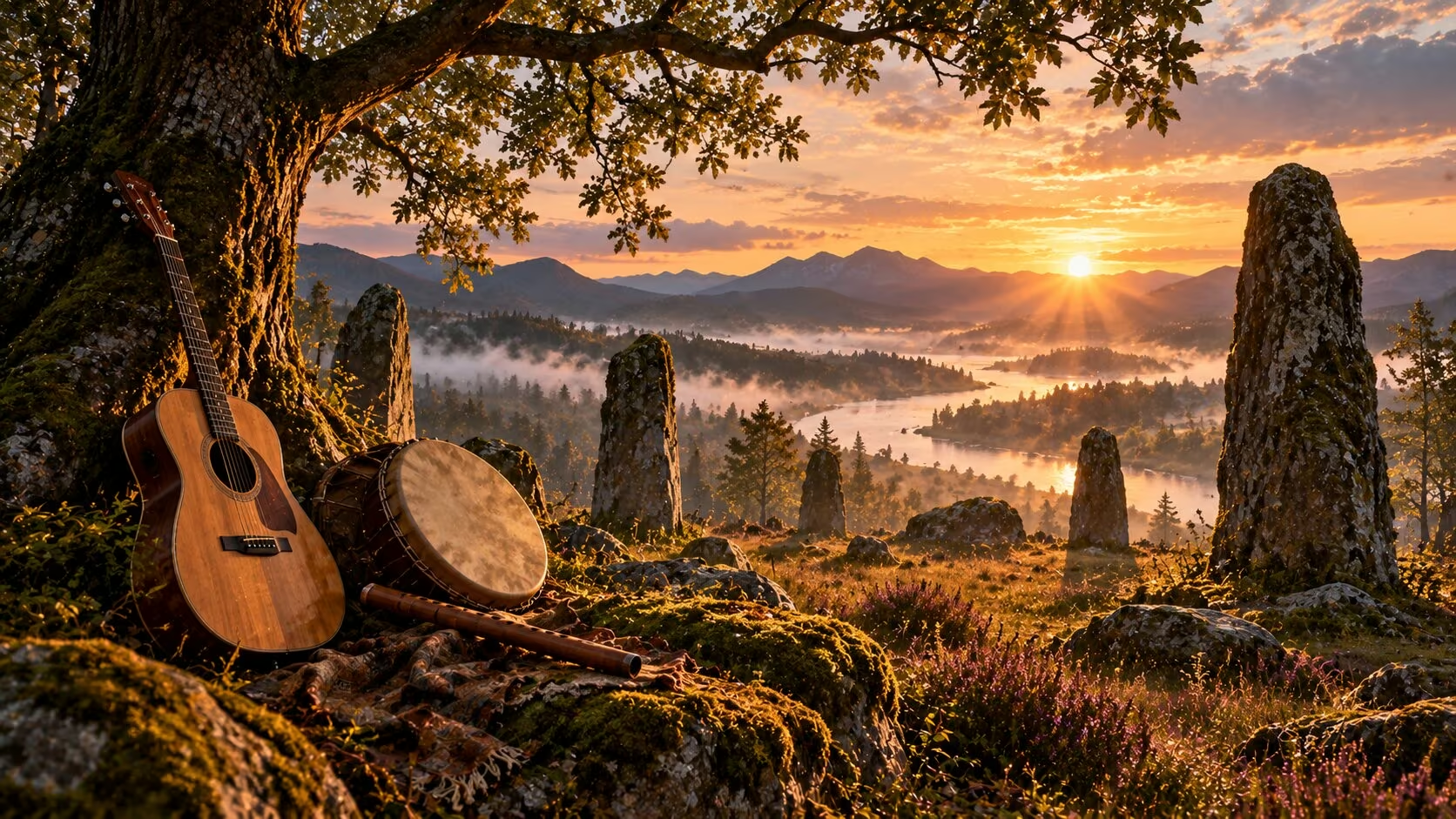
This page is about the meeting point of folk tradition and rock ambition: fiddles, crumhorns, lutes, pipes and cellos inside long, arranged pieces and concept albums. It gathers eight progressive folk bands, from Dublin, London, Montreal and Stockholm to York and Glastonbury, and points to the better-known names that live elsewhere on this site.
The short version
The label has two lives. Reference works such as AllMusic use it for folk that grows out of the detailed, inward-looking songwriting of the post-Dylan era, made more complex in both music and words and often coloured by other ethnic traditions. On this site I use it more narrowly, for bands where folk instruments, melodies and stories meet the long forms and electric arrangements of progressive rock. That meeting happened first in Britain in the late 1960s, when folk clubs, the psychedelic underground and the first prog bands overlapped. Comus and Renaissance sat right on the border between progressive folk and progressive rock. Within a few years the same border was being crossed in Dublin by Horslips, in Montreal by Harmonium and in Stockholm by Kebnekajse.
From folk clubs to concept albums
The British story begins with the second folk revival, which filled the country with folk clubs from the late 1950s. By the mid-1960s radio stations were using the word “progressive” for psychedelic music of every kind, folk included. The Incredible String Band brought medieval and Eastern instruments into its acoustic music from 1967; Fairport Convention and Steeleye Span pioneered British folk rock from 1969; and a group of acts, Amazing Blondel among them, turned towards older, traditional material.
Amazing Blondel came out of Scunthorpe. In 1969 John Gladwin and Terry Wincott left the loud electric band Methuselah to play acoustic music, and with their school friend Eddie Baird they built a sound on lute, cittern, crumhorn, recorders and harmonium. Wincott later called it “pseudo-Elizabethan/Classical acoustic music”. Members of Free introduced the trio to Chris Blackwell, who signed it to Island for “Evensong” (1970), “Fantasia Lindum” (1971) and “England” (1972).
Gryphon took the same early music into rock. Richard Harvey and Brian Gulland, both graduates of the Royal College of Music, started the band in London in early 1972, and Graeme Taylor and Dave Oberlé soon joined. Their 1973 debut on Transatlantic mixed English folk with medieval and Renaissance music and added electric guitars, keyboards, bassoon and krumhorn. Classic Rock magazine called the result “renaissance rock taken to such an extreme”. From November 1974 to May 1975 Gryphon opened for Yes across the United States, Canada and the UK, sometimes joining them on stage for the encores.
Ireland produced its own version. Horslips formed in Dublin in 1970, set up their own label, Oats, and licensed their records abroad through Atco, RCA and DJM. “The Táin” (1973) was written for a stage adaptation at the Abbey Theatre of the Táin Bó Cúailnge, the tenth-century tale of a war between Ulster and Connacht. “The Book of Invasions: A Celtic Symphony” turned more Irish legends into a single story; it entered the Official Albums Chart on 30 April 1977 and peaked at No. 39, the band’s only entry on that chart.
Across the Atlantic, Harmonium formed in Montreal in 1972 around Serge Fiori and Michel Normandeau, with Louis Valois joining in 1973. The band released three studio albums between 1974 and 1976, all with French titles, and Bob Mersereau’s 2007 book “The Top 100 Canadian Albums” included all three. In Sweden, Kebnekajse took shape in Stockholm in 1971, after some of its members had left Mecki Mark Men. The band drew on traditional Swedish folk music and on African music, moving from hard rock towards folk, symphonic rock and jazz fusion, and it belongs to the progg movement of the 1970s. In Sweden at the time, “progressive” was a political label more than a musical one.
The second wave
The style came back in the late 1980s and 1990s. Iona grew out of an idea David Fitzgerald brought back from a trip to Lindisfarne in November 1988 and shared with Dave Bainbridge; the band played its first recorded gig in June 1989, with Joanne Hogg on vocals, and built its music around Celtic and Christian themes. Mostly Autumn formed in York in 1995 around guitarist and singer Bryan Josh. The BBC described the band as blending Genesis and Pink Floyd with Celtic themes and hard rock, and it has been compared with Renaissance, Jethro Tull and Camel. Its fifteenth studio album, “Seawater”, came out in 2025.
Moulettes, formed in Glastonbury in 2002 by a group of school friends, are a band led by the cello, with bassoon and three-part vocal harmonies. Reference articles on the genre name them among the most prominent progressive folk acts in the UK in the early 2010s. I explain the term and its two meanings in more detail in my article What Is Prog Folk?, and my list of the best prog rock albums inspired by folklore follows old legends across the wider prog world.
If this is your scene, my books go deeper →
The bands in this guide
Eight bands from four countries, from the first wave of the early 1970s to the British bands who picked up the thread decades later. Each card opens the band’s page and its album guides.
Elsewhere on Prog Atlas
Several of the progressive folk records most often cited are by bands I cover in my British Progressive Rock section. Jethro Tull blended hard rock with English folk and classical music, and in the late 1970s released three folk rock albums in a row: “Songs from the Wood”, “Heavy Horses” and “Stormwatch”. The band was never formally part of the folk rock movement, but it had long ties to Steeleye Span and played with members of Fairport Convention. The Strawbs began in London in 1963 as a bluegrass duo, the Strawberry Hill Boys; Sandy Denny sang with them in 1967 before she joined Fairport Convention, and in the 1970s they turned towards progressive rock. Rick Wakeman played on “Dragonfly” (1970) and stayed for “From the Witchwood” (1971) before he left for Yes, the band Gryphon later toured with.
Comus was formed in London in 1969 by the art students Roger Wootton and Glenn Goring, who developed their sound in the folk clubs around Bromley. Renaissance, started in January 1969 by the former Yardbirds Keith Relf and Jim McCarty, combined classical, folk, rock and jazz. Gentle Giant drew on folk among many other sources and on the music of the Middle Ages and the Renaissance, the same territory Gryphon explored. Mike Oldfield started out in folk: from 1967 to 1970 he and his sister Sally were the duo The Sallyangie, whose only album, “Children of the Sun” (1969), came out on Transatlantic, the label that later issued Gryphon’s debut.
The second wave has its own links. Founding members of Mostly Autumn had played in a tribute band to Pink Floyd, and in autumn 2014 Bryan Josh and Olivia Sparnenn, as Mostly Autumn Acoustic, supported Steve Hackett on the UK leg of his “Genesis Extended” tour; the BBC comparison above names Genesis too. Arthur Brown, the singer behind Kingdom Come, appeared as a guest on the Moulettes album “Constellations”. Far from Britain, Los Jaivas, formed in Viña del Mar, Chile, in 1963, mixed rock with the ancestral music of South America.
Where to start
I would start in Dublin with “The Táin” (1973), the Horslips album that grew out of a theatre adaptation of an old Irish epic. Then go to London for “Midnight Mushrumps” (1974): its title comes from a phrase in Shakespeare’s “The Tempest”, for which Gryphon wrote music in Peter Hall’s National Theatre production, and its title track was conceived by Richard Harvey. For the acoustic, early-music side, “Evensong” (1970) is the first of Amazing Blondel’s Island albums. In Montreal, “Les cinq saisons” (1975) is the Harmonium album Rolling Stone’s Ryan Reed ranked 36th among the 50 greatest prog rock albums in 2015, naming it the best progressive folk album of all. For the second wave, Iona’s “The Book of Kells” (1992) is a concept album built on the eighth-century illuminated manuscript. And from the British side of the site, “Songs from the Wood” (1977) opened Jethro Tull’s folk rock run and was the first Tull album since 1972 to receive generally positive reviews, while “First Utterance” (1971), the largely acoustic Comus debut, received five stars out of five from Tiny Mix Tapes.
Related scenes
Most of the founders of this style are in British Progressive Rock. The psychedelic folk of the late 1960s connects to Psychedelic & Space Rock, while the classical and orchestral side of the story continues in Symphonic Progressive Rock. Bands that mix prog with other popular styles are gathered in Crossover Prog.